

Mohamed Abd Elrahman
6Dec2025
Before the hieroglyphs were understood, the strange animal-headed gods depicted alongside the mysterious hieroglyphs were thought to be divine messages or magical formulas .
The language of ancient Egypt spoken by the pharaohs of ancient Egypt is simply referred to as “Ancient Egyptian.” The language has been extinct for 1500 years and is no longer used for communication. The last vestiges of the language have been preserved in Coptic, but this too has not been spoken for centuries. The modern inhabitants of the Nile Valley speak Arabic .
Ancient Egyptian was based on an alphabet of 24 consonants, not all of which correspond to European alphabets. As in Arabic and Hebrew, the vowels were not written but had to be provided by the reader or speaker. However, there are a number of indications regarding the vowel sounds in Coptic, which is a late form of the Egyptian language that has survived to the present day. When transcribing Egyptian words, the general rule used by Egyptologists was that if there were clues in Coptic, use them, otherwise add an ‘e’ to the words until you get something pronounceable to European ears. The transcriptions were made mostly by English, French and German Egyptologists using their own language, resulting in wide variations of the names of the pharaohs.
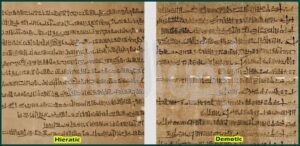
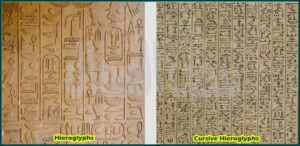
Scribes were highly educated individuals who were responsible for record-keeping, drafting legal documents, and maintaining religious texts. Three distinct scripts were in use. The most common was Hieratic, used for everyday transactions like inventory, wages and tax records. Artisans also used hieratic to mark their finished products. Cursive Hieroglyphs were reserved for religious texts, while Hieroglyphs were used for inscriptions on monuments erected in honour of kings and other prominent figures. Hieratic writing was mostly done in ink on papyrus, while hieroglyphs were carved onto more durable materials such as stone, metal, wood, and so on.
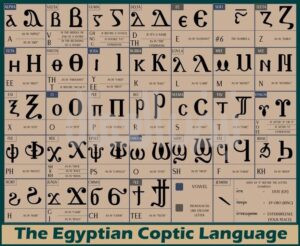
After the conquest by Alexander the Great, hieratic and Demotic were slowly supplanted by transcriptions of Greek characters incorporating Demotic signs for Egyptian phonemes. This final version of the Egyptian language is known as Coptic. The Coptic alphabet ( ϣ ϥϧϩϫϭϯ) remained in use in Egypt until the Muslim conquest of the seventh century, when it was replaced by Arabic as the written language of daily life. The spoken Coptic language itself proved somewhat more resilient, surviving for centuries despite the Arabic hegemony Even to this day. It is used in Christian congregational prayers.